
Notes on The 5 Kingdoms:
1.Animalia
2.Plantae
3.Fungi
4.Protocista
5.Monera (also known as 'Prokaryota')
Animalia:
Cell type: Eukaryotic
Organisation: Multicellular
Nutrition: Heterotrophs
Reproduction: Mostly sexual with haploid gametes
Examples: Sponges / Flatworms / Fish
Although not the largest phylum, Chordata contains the most familiar species, including humans. All chordates have several things in common that occur at some stage of development. They have pharyngeal slits, which are openings that connect the inside of the throat to the outside of the neck. These are often used as gills. Their main feature, what they are named after, is the notochord, which is a rod that supports the nerve cord. The nerve cord is also present in all species. This is a bundle of nerve fibers which connect the brain with the muscles and organs, and is through which messages from the brain are sent. A tail is also present, which extends past the anal opening. In most species these features disappear with age. For example, the pharyngeal slits are only present in the human fetus. There are approx 44 000 species in 3 subphylums:
1. Cephalochordata
This is a small, very unusual subphylum of creatures commonly called lancelets or amphioxus. These animals are fish-like in appearance, but are invertebrates with a notochord, and a nerve cord right above it. They lack bones, a brain, eyes, and most other organs associated with the brain. There are 25 species, and they do not seem to be placed in any class. However, some experts do not call this a subphylum and they place it in a class of the same name:
Cephalochordata (lancelets)
2. Tunicata (Urochordata)
This is a large subphylum of unusual invertebrates that do not look like anything much more than a strange underwater worm or mushroom. They start off life as tadpole-like larvae with notochords and all the rest. This stage lasts only a short time, after which they anchor to the seabed and live a sedentary life. They completely change shape at this point, and it is hard to believe that they are in the same phylum as humans. The adults lack the notochord but do keep the pharyngeal slits. They have a highly-developed internal structure, with a heart and other organs. Tunicates are named for their protective covering, known as a tunic. This tunic is made up of cellulose, which is very rare in animals. There are 2000 species in 4 classes:
Appendicularia or Larvacea (free swimming tunicates)
Ascidiaceae (sea squirts)
Sorberacea (benthic tunicates)
Thaliacea (salps)
3. Vertebrata
This is the largest subphylum with the more well-known animals, including humans, reptiles, fish, etc. Every animal with a backbone is present in this subphylum. The notochord is developed at an early age, and is replaced with vertebrate. All vertebrates have a skeleton of either bone or cartilage. Their brain is protected by a boney cranium, and consists of three parts. They all have well-developed hearts with 2-4 chambers and have a closed circulatory system. There are 41700 species in 8 classes:
Amphibia (frogs, salamanders)
Aves (birds)
Cephalaspidomorphi (Lampreys)
Chondrichthyes (cartilaginous fish)
Mammalia (mammals)
Myxini (Hagfish)
Osteichthyes (bony fish)
Reptilia (crocodiles, snakes, turtles)
1. Class Osteichthyes includes all bony fishes. Like all fishes, Osteichthyes are cold-blooded vertebrates that breathe through gills and use fins for swimming. Bony fishes share several distinguishing features: a skeleton of bone, scales, paired fins, one pair of gill openings, jaws, and paired nostrils.
2. Osteichthyes includes the largest number of living species of all scientific classes of vertebrates, more than 28,000 species.
3. Osteichthyes account for about 96% of all fish species. Fishes not included in the Osteichthyes are the Chondrichthyes (sharks and their relatives), the Myxini (hagfishes), and the Cephalaspidomorphi (lampreys).
1. Living Osteichthyes are divided into three subclasses: Dipnoi, Crossopterygii, and Actinopterygii.
• The subclass Dipnoi (lungfishes) is characterized by an upper jaw fused to the braincase, fused teeth, and the presence of an air-breathing organ that opens to the esophagus. A lungfish's caudal fin is continuous with its dorsal and anal fins. Its pelvic and pectoral fins are long and tubular.
• The subclass Crossopterygii (coelacanths) is characterized by a type of primitive scale called a cosmoid scale, two dorsal fins, and fleshy paired fins that contain skeletal elements. Scientists used to think that this entire subclass of fishes was extinct. Then in 1938, a living coelacanth (Latimeria chalumnae) was discovered off the coast of Southeast Africa. Several specimens have since been collected. • The subclass Actinopterygii includes all other living bony fishes. Actinopterygians are characterized by fins that are supported by bony elements called rays.
There are about 34 orders in two subclasses:
Subclass Sarcopterygii (fleshy-finned fish)
1) Crossopterygii - Coelacanthimorpha (coelacanth)
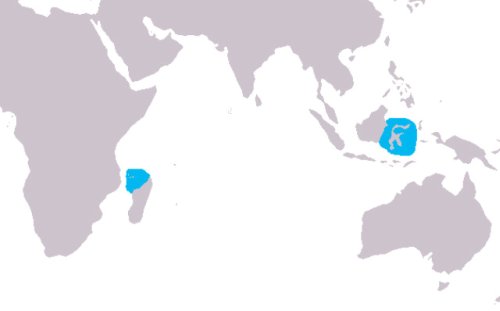
Ranges of Coelacanth Species
2) Ceratodiformes (Australian lungfish)
3) Lepidosireniformes (South American lungfish)
Subclass Actinopterygii (ray-finned fish)
Polypteriformes (bichir, redfish)
Acipensiformes (paddlefish, sturgeon)
Amiiformes (bowfin, garpike)
Elopiformes (tarpon, tenpounder)
Anguilliformes (eel)
Notacanthiformes (spiny eel)
Clupeiformes (herring, anchovy)
Osteoglossiformes (arapaima)
Mormyriformes (elephant-trunk fish)
Salmoniformes (salmon, trout)
Gonorhynchiformes (milkfish)
Cypriniformes (carp, barbs, loach, livebearers)
Siluriformes (catfish)
Myctophiformes (lantern fish, Bombay duck)
Percopsiformes (pirate perch)
Batrachoidiformes (toadfish)
Gobiesociformes (clingfish, gobies, dragonets)
Lophiiformes (anglerfish)
Gadiformes (cod, pollack)
Atheriniformes (flying fish)
Lampridiformes (opah, ribbonfish)
Beryciformes (squirrelfish)
Zeiformes (John Dory)
Gasterosteiformes (seahorse, stickleback)
Channiformes (snakeshead)
Synbranchiformes (swamp eels)
Scorpaeniformes (scorpionfish, gurnard)
Dactylopteriformes (flying gurnard)
Pegasiformes (sea-moth)
Pleuronectiformes (flatfish)
Tetraodontiformes (triggerfish, ocean sunfish, pufferfish)
Perciformes (perch, cichlid, gobies, wrasse, tuna, swordfish, ice fish)
1. All orders of bony fishes end in the suffix "iformes".
2. While there is debate over how certain fishes should be classified, scientists recognize more than 500 different bony fish families. The names of bony fish families all end in the suffix "dae".
1. More than 28,000 species of bony fishes have been documented. It's likely that many more, including some deep-sea species, have yet to be identified.
Evolution of Fish
1. Primitive fishes date back to the Cambrian period, about 550 million years ago. These jawless fishes lived relatively unchanged over the following 100 million years.
2. The Devonian period, about 360 to 400 million years ago, is known as the "Age of Fishes", because of the abundance and diversity of fishes that appeared during this period.
• In the Devonian, fishes began to develop jaws and paired fins. All four living classes of fishes and the three subclasses of Osteichthyes were established by the mid-Devonian.
• Many species of fish that lived during the Devonian are now extinct.
3. Bony fishes continued to evolve after the Devonian period.
• Most modern orders of bony fishes probably evolved during the Triassic period, about 200 million years ago.
• Today, the Actinoptergians are the dominant vertebrates in the oceans and in freshwater systems.
• The most recently evolved orders of bony fishes include the Pleuronectiformes (flatfishes) and Tetraodontiformes (triggerfishes, pufferfishes, and molas).
